Friday, November 27, 2015

Can We Admit the Greed in Ourselves?


I think greed gets the best of everybody.  Greed is destructive (please don't justify it by calling it Capitalism).  Greed, like the love of comfort, is based in fear.


He who is greedy is always in want.  It is an insatiable hunger.  Unquenchable.


It is one of the ugliest sides of humanity, a gate to hell, like lust and anger.


We deny it is in us, there is always someone we perceive as worse than us to point to as justification for our behavior.


I don't want to pontificate in an area where I myself am so weak.  This is truly one of those areas Buddha spoke of when he saids, "When the student is ready a teacher appears".  May the wisdom of a wide array of Greater Minds take seed in the fertile soul of a receptive mind.


“He who is not contented with what he has, would not be contented with what he would like to have.” 
― Socrates


“So the unwanting soul
sees what's hidden,
and the ever-wanting soul
sees only what it wants.” 
― Lao Tzu


“What win I, if I gain the thing I seek?
A dream, a breath, a froth of fleeting joy.
Who buys a minute's mirth to wail a week?
Or sells eternity to get a toy?
For one sweet grape who will the vine destroy?
Or what fond beggar, but to touch the crown,
Would with the sceptre straight be strucken down?” 
― William ShakespeareThe Rape of Lucrece


Greed is not a financial issue. It's a heart issue.  ~
Andy Stanley


But those who want to get rich fall into temptation and a snare and many foolish and harmful desires which plunge men into ruin and destruction. For the love of money is a root of all sorts of evil, and some by longing for it have wandered away from the faith and pierced themselves with many griefs. 

-1 Timothy 6:9-10

“Watch out! Be on your guard against all kinds of greed; a man’s life does not consist in the abundance of his possessions” (Luke 12:15). 


“Do not store up for yourselves treasures on earth, where moth and rust destroy and where thieves break in and steal… You cannot serve both God and money” (Matthew 6:19 and 24).


I am going to close this out with a survey from Christianity today which gives me insight into my own behavior.  Take some time with your answers in prayer, ask our Father to breathe into us what he wants to see develop in your heart...

To help you focus your own self-examination, answer the following questions. The questionnaire is a rough measure of your generosity. The questions provide only a generous and a greedy option. The import of the answer given may vary with the circumstances of the one giving the answer. It would be wrong to quantify your responses. The point is not to rate yourself, but to position yourself better to fight the spiritual battle.
  1. If I fantasize about winning a magazine sweepstakes, what most comes to mind is: (a) what I could do for others with all that money; (b) what I could buy, the vacations I could take, and the freedom to do what I want.
  2. When I hear of someone with about the same talents and energy and education as I have who earns $20,000 a year more than I do, I think: (a) how nice that he or she can earn that much money; (b) it's not fair.
  3. When someone outside my family gives me a significant gift "out of the blue": (a) I feel good about being the recipient of that person's generosity, and am comfortable with remaining in his or her "debt"; (b) I refuse it, or if I accept it I feel uncomfortable until I have given the giver something of equal or greater value.
  4. If I express my admiration for some possession of an acquaintance (a book, a painting, a piece of pottery), and the acquaintance offers to give it to me, I tend to think: (a) "This person is very generous"; (b) "What do you suppose he or she wants from me?"
  5. When I give someone a gift: (a) I am content if the person acknowledges the gift with pleasure; (b) I feel cheated if the person doesn't pretty soon do me a favor or give me a gift of equal or greater value.
  6. When I give money to the church or other charitable organization, I typically: (a) think with pleasure about the good that may be done with my money; (b) think of the things I could have done with the money if I hadn't given it away.
  7. If I lend $15 to someone I meet at a retreat: (a) I don't mind much if I never see the money again; (b) I get pretty upset if the person doesn't repay me.
  8. When I give money to the church, I do so because: (a) I like to see the church doing well; (b) I feel it wouldn't be right to not give.
  9. When I get a significant raise or come into some money: (a) it does not affect my standard of living; (b) my standard of living increases.
  10. When I get a raise or switch to a higher income job: (a) my feelings about myself don't change much; (b) I tend to feel very good about myself for a while, but soon I begin to feel "poor" again.
  11. When something of value is being distributed in a group—fish at the end of a fishing trip or leftover food at a picnic—if I can manage to get a bit more for myself than others without seeming greedy: (a) I will not do it; (b) I will do it.


The Entitlement Trap


Christmas has become the epitome of entitlement thinking:
"My family deserves _______."
"I feel I have earned ______."
"I can't afford this, but my ______ is worth it."
"That will be credit, please."
"But Honey, it was such a good deal I couldn't pass it up!"

The Black Friday shopping is creeping up to the week before Thanksgiving, with the ravenous quest for deals inserting itself in advance of Thanksgiving.  Many stores are open on Thanksgiving day offering pre-Black Friday deals.  Some feel they are entitled to a season of shopping.

I am reading a book by John Townsend called "The Entitlement Cure".  In it he says, 

“Entitlement is the belief that I am exempt from responsibility and I am owed special treatment.” 

“Entitlement is: The man who thinks he is above all the rules. The woman who feels mistreated and                  needs others to make it up to her.” 

Entitlement has us believe that the world owes us something because of who we are.  It is our sense of justice gone rogue in a very selfish way.  It is the avoidance of the Hard Way that leads us to where we are suppose to be.

Here are other's thoughts on the entitlement trap...


“You cannot help people permanently by doing for them, what they could and should do for themselves.” 
― Abraham Lincoln

“When we replace a sense of service and gratitude with a sense of entitlement and expectation, we quickly see the demise of our relationships, society, and economy.” 
― Steve Maraboli

“Legalism breeds a sense of entitlement that turns us into complainers.” 
― Tullian Tchividjian

“Taking things for granted is a terrible disease. We should all be checking ourselves regularly for signs of it.” 
― Kate Tempest

“There's a whole generation growing up thinking...the government exists to care for them.” 
― Dave Ramsey

“They all want to be happy. They all think they should be happy. And they’re quick to trot out their most cherished document and point to where they were promised “life, liberty and the pursuit of happiness.” But you’ll find that though they all parrot that little phrase, they think none too hard about that word “pursuit”. To follow, to chase, to inquire, to hunt, to seek. To track in order to overtake and capture. This they don’t do. Instead, having been offered a promise of happiness, they progress to a feeling of entitlement for happiness, then make the leap that happiness should, therefore, be easily won, automatic. There’s too much wrong in there to even scratch at that!” 
― Geoffrey Wood

Entitlement is dependence, expectation that someone else is responsible for our happiness, provision and status quo.

I wonder what (or who)  in our lives is taken for granted as "our right to have"?


Wednesday, November 25, 2015

Generosity: Letting Go of What Holds You


In John Wesley’s famous sermon, “The Use of Money,” which is an extended examination of Luke 16:9 - I have been thinking what our world might look like if God gave us courage to live out these words from the sermon’s conclusion:
Gain all you can, without hurting either yourself or your neighbor, in soul or body, by applying hereto with unintermitted diligence, and with all the understanding which God has given you; save all you can, by cutting off every expense which serves only to indulge foolish desire; to gratify either the desire of flesh, the desire of the eye, or the pride of life; waste nothing, living or dying, on sin or folly, whether for yourself or your children; and then, give all you can, or, in other words, give all you have to God. Do not stint yourself . . . to this or that proportion. “Render unto God,” not a tenth, not a third, not half, but all that is God's, be it more or less; by employing all on yourself, your household, the household of faith, and all mankind, in such a manner, that you may give a good account of your stewardship when ye can be no longer stewards.
That is radical generosity.  That is not the words of someone who has one foot in this world and the other in Heaven.


Giving is about willingness, not about a percentage, or a duty or giving to God.  Newsflash-  God doesn't need you in order to save the world.  Real giving is not a transaction, you will never balance the scales - God will always outgive you.  Giving is acknowledging who every good thing in your life belongs to and where it comes from.
“But woe to you who are rich, for you have received your consolation. Woe to you who are full now, for you shall be hungry” (Lk 6:24)
“Give to everyone who begs from you, and from one who takes away your goods do not demand them back” (Lk 6:30). “Jesus said to him, ‘If you would be perfect, go, sell what you possess and give to the poor, and you will have treasure in heaven; and come, follow me.’ When the young man heard this, he went away sorrowful, for he had great possessions” (Mt 19:21)


James exhorted Christians to live out their faith, saying, “If a brother or sister is poorly clothed and lacking in daily food, and one of you says to them, ‘Go in peace, be warmed and filled,’ without giving them the things needed for the body, what good is that?” (Jam 2:15-16). The story of the rich young man is in the Gospel for a reason—we cannot ignore it. If Jesus says, “Sell what you possess and give to the poor,” why do Christians not do what He commands?


“The mark of such a sacrificial life is eager willingness to give up comfort and privilege when that will help the weak,”  ~ Roger Olsen

“I appeal to you therefore, brothers and sisters, by the mercies of God, to present your bodies as a living sacrifice, holy and acceptable to God, which is your spiritual worship. Do not be conformed to this world, but be transformed by the renewing of your minds, so that you may discern what is the will of God – what is good and acceptable and perfect. For by the grace given to me I say to everyone among you not to think of yourself more highly than you ought to think, but to think with sober judgement, each according to the measure of faith that God has assigned.   ~ Romans 12:1-4

Monday, November 23, 2015

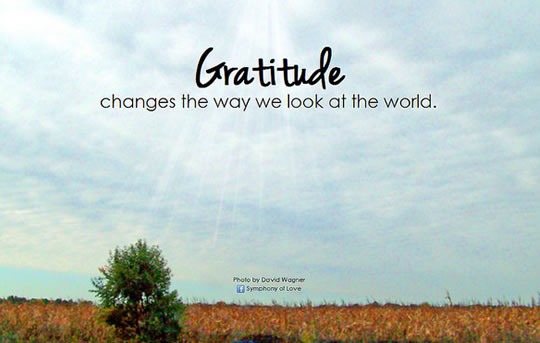
Gratitude


When a new day begins, dare to smile gratefully.
When there is darkness, dare to be the first to shine a light.
When there is injustice, dare to be the first to condemn it.
When something seems difficult, dare to do it anyway.
When life seems to beat you down, dare to fight back.
When there seems to be no hope, dare to find some.
When you’re feeling tired, dare to keep going.
When times are tough, dare to be tougher.
When love hurts you, dare to love again.
When someone is hurting, dare to help them heal.
When another is lost, dare to help them find the way.
When a friend falls, dare to be the first to extend a hand.
When you cross paths with another, dare to make them smile.
When you feel great, dare to help someone else feel great too.
When the day has ended, dare to feel as you’ve done your best.
Dare to be the best you can –
At all times, Dare to be!”
― Steve Maraboli, Life, the Truth, and Being Free

“The more I understand the mind and the human experience, the more I begin to suspect there is no such thing as unhappiness; there is only ungratefulness.” 
― Steve Maraboli

“Gratitude is the ability to experience life as a gift. It liberates us from the prison of self-preoccupation.” 
― John Ortberg

“He who does not reflect his life back to God in gratitude does not know himself.” 
― Albert Schweitzer


“What separates privilege from entitlement is gratitude.” 
― Brené Brown

“I used to think how lucky she was to have me, but now I realize that’s backwards. A spirit of gratitude yields patience, love, and forgiveness.” 
― Jarod Kintz

“Gratitude looks to the Past and love to the Present; fear, avarice, lust, and ambition look ahead.” 
― C.S. Lewis, The Screwtape Letters

“In normal life we hardly realize how much more we receive than we give, and life cannot be rich without such gratitude. It is so easy to overestimate the importance of our own achievements compared with what we owe to the help of others.” 
― Dietrich Bonhoeffer

“When we give cheerfully and accept gratefully, everyone is blessed.” 
― Maya Angelou


“Do not spoil what you have by desiring what you have not; remember that what you now have was once among the things you only hoped for.” 
― Epicurus

“The miracle is not to walk on water. The miracle is to walk on the green earth, dwelling deeply in the present moment and feeling truly alive.” 
― Thích Nhất Hạnh

Saturday, November 14, 2015

Suffering Other's Sin


I awoke this morning with a profound urge to pray. I found a very personal answer to a question in this....

"For Christ also suffered once for sins, the righteous for the unrighteous, to bring you to God. He was put to death in the body but made alive in the Spirit." ~1 Peter 3:18 NIV

It is easy to see the sinfulness in others. not so easy to suffer for others in spite of that sin. That is righteousness.

We do not have the righteousness in us, it is only because of Jesus and the work of the Holy Spirit that we can suffer other's sin. We talk about judging others, but what is really at hand is suffering through another's sin while battling our own sinful response.

The human condition after the Fall is that sin begets sin.  A vicious cycle